A whole-home surge protector fits residences running sensitive electronic loads, variable-speed HVAC compressors, heat pump water heaters, and Level 2 EV charging stations. Point-of-use power strips merely absorb…
A whole-home surge protector fits residences running sensitive electronic loads, variable-speed HVAC compressors, heat pump water heaters, and Level 2 EV charging stations. Point-of-use power strips merely absorb localized downstream spikes up to a limited joule rating; in contrast, a panel-mounted surge protective device (SPD) arrests transient voltages up to 100,000 amps directly at the service entrance. The trade-off involves breaker space: installing a Type 2 unit requires two open vertical breaker spaces in the existing panel. When an older 100-amp split-bus panel in Los Feliz, Echo Park, or Silver Lake lacks physical slots or contains obsolete Zinsco or Federal Pacific equipment, resolving space limitations requires either a tandem-breaker consolidation, a dedicated external enclosure, or a full 200-amp service upgrade.
Transient spikes in Los Angeles County originate from two distinct sources: external grid events from the Los Angeles Department of Water and Power (LADWP) or Southern California Edison (SCE) distribution switching, and internal inductive loads cycling on and off. In hillside neighborhoods like Studio City and Sherman Oaks, high ambient temperatures trigger continuous cycling of large 4-ton and 5-ton central air compressors, generating internal micro-surges that degrade control boards over time. Near coastal zones such as Venice and Mar Vista, salt-air exposure accelerates oxidation on grounding electrode conductors, increasing ground resistance and diminishing the discharge speed of transient voltage suppression devices. Ground path resistance must be measured to verify the home's grounding system stays below the 25-ohm threshold mandated by electrical code.
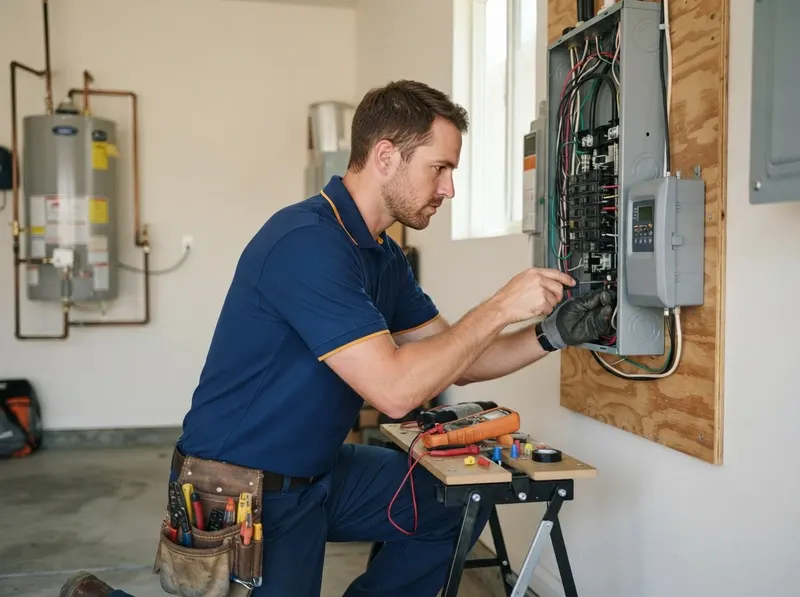
Installing panel-level protection involves precise mechanical and electrical steps. 1. De-energize the main disconnect to test voltage absence across all panel terminals using a calibrated multimeter. 2. Mount the surge device adjacent to the main breaker to keep conductor leads shorter than 12 inches, minimizing line inductance. 3. Connect the surge device leads to a dedicated 20-amp or 30-amp two-pole circuit breaker while routing neutral and equipment grounding conductors to their respective busbars. 4. Re-energize the service and inspect the illuminated status-indicator LEDs to verify phase-to-neutral and phase-to-ground clamp pathways. In classic Craftsman and Spanish Colonial properties throughout Highland Park, Westwood, and Boyle Heights, ungrounded two-wire branch systems limit surge paths; installing a code-compliant grounding electrode system with dual ground rods spaced at least 6 feet apart is required for the surge unit to divert transients.
Every job gets a firm, written price after a free on-site visit.
Tell us about your whole-home surge protection systems job in los angeles and we'll send a clear, written quote, usually the same day.
 Elite Electrician